Don't Get Trapped By the Legal System — Know your Rights Before it's too late!
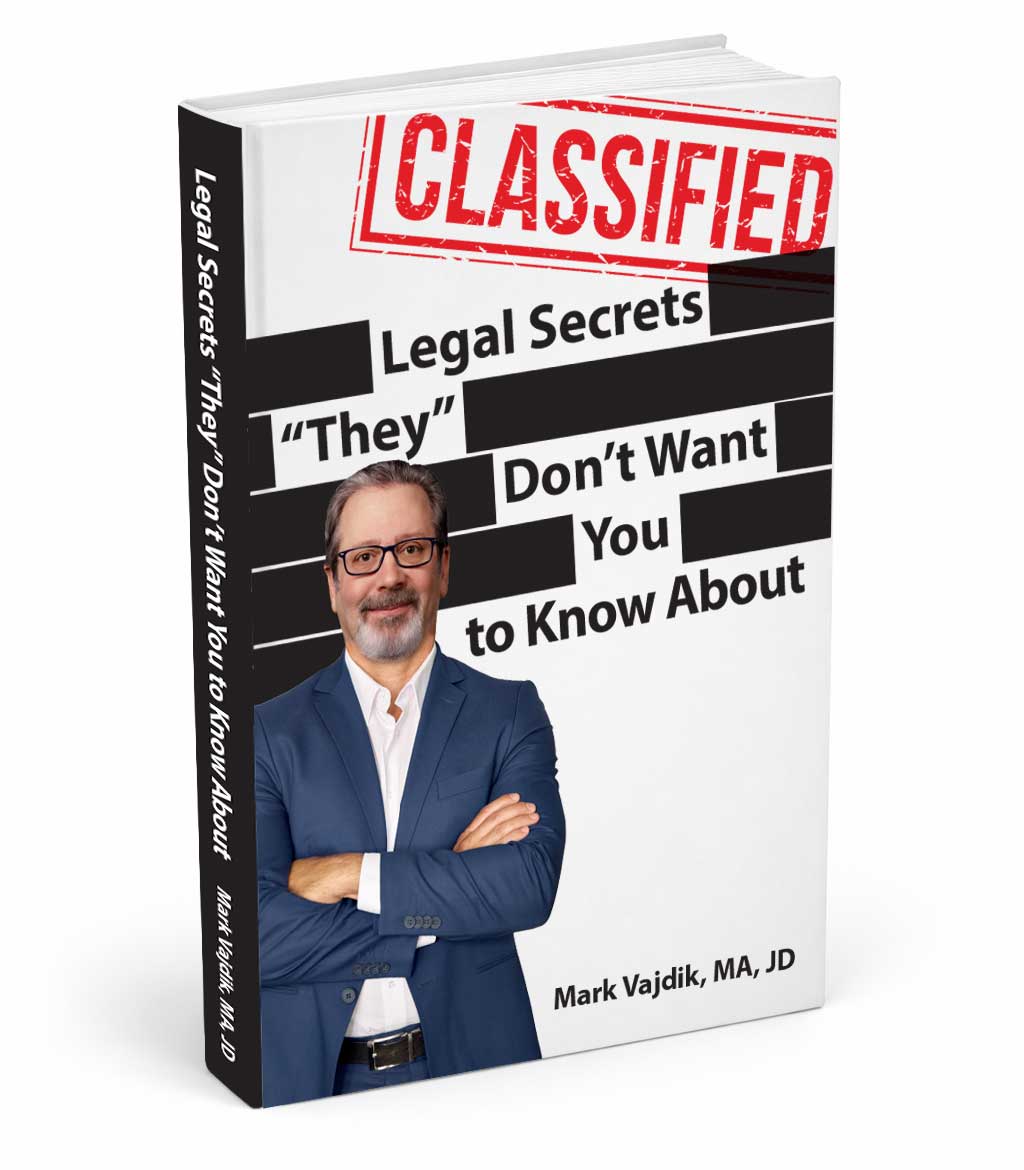
“The law was written to give the advantage to the system. I wrote ‘Legal Secrets “They” Don’t Want You to Know About‘ to give the advantage back to everyday people!”
– Mark Vajdik, MA, JD
The law can be a powerful weapon for people who know how to use it — and a costly trap for people who don’t.
Every day, legal “loopholes,” technicalities, deadlines, exceptions, fine print, and rules most people have never been taught can mean the difference between winning or losing, being protected or exposed, keeping your money or giving it up, and knowing your rights or realizing them when it’s already too late.
The rich, powerful, corporations, insurance companies, and the lawyers who represent them have understood how the legal system works for generations.
Why shouldn’t you?
Legal Secrets “They” Don’t Want You To Know About gives everyday people a plain-English legal guide to the rights, risks, rules, and “gotcha” moments hiding inside ordinary life — so you can recognize them before somebody else uses your lack of knowledge to their advantage.
The system already knows the rules. It’s time you did, too.
Buy direct here and save. Also available at:



Test Your Legal Knowledge
The law is loaded with unexpected twists, exceptions, technicalities, and traps that can cost you money, rights, opportunities, and peace of mind — even when you’re absolutely convinced you’re in the clear.
Think you know your rights?
Let’s find out.
You may be surprised by what you don’t know.
Can't I Just A.I. This?
Everybody has Google. Everybody has AI. So why buy a book about legal rights?
Because Google and AI can only answer the question you know enough to ask.
And that’s where people get trapped.
By the time you realize you should have asked whether you had to sign that document, answer that question, meet that deadline, accept that settlement, respond to that notice, keep that message, protect that property, or call an attorney…
the damage may already be done.
One of the biggest lessons readers discover in Legal Secrets “They” Don’t Want You To Know About is that legal problems don’t always announce themselves as legal problems.
Sometimes they look like:
- a routine form at work,
- a friendly conversation,
- an insurance-company phone call,
- a harmless social-media post,
- a handshake agreement,
- a letter you almost threw away,
- or a decision you made because “everybody does it.”
You can’t Google the question you didn’t know you needed to ask.
That’s why Legal Secrets isn’t just about answering legal questions.
It’s about helping you see them coming.
Legal Secrets That Can Affect Almost Every Part Of Your Life
The law touches virtually every part of everyday life — whether you’re a billionaire with a team of attorneys or an average person trying to work, raise a family, protect your money, own property, and stay out of trouble.
That’s exactly why Legal Secrets includes 50 chapters covering legal rights, legal mistakes, and areas of law that affect people across virtually every walk of life.
- How to Pick the Right Attorney
- Employment & Workplace Law
- Contracts & Agreements
- Tax Law
- Personal Injury Law
- Insurance Claims
- Estate Planning & Probate
- Criminal Law & Police Encounters
- Real Estate & Property Law
- Family Law
- Consumer Rights & Debt
- Intellectual Property Law
- Medical & Professional Malpractice
- Digital Privacy & Social Media
- And much more
Every chapter was designed to help expose the legal “gotcha” moments most people never see coming — until they’re already caught in one.
Did You Know...?
How well do you really know your legal rights?
Here are just a few everyday legal facts, traps, and misconceptions that can change what happens when the law suddenly becomes your problem.
How does the law affect everyday life without you realizing it?
Almost constantly.
Contracts you sign. Insurance policies you buy. Employment paperwork. Traffic stops. Debt. Property. Social media. Family decisions. Wills. Business agreements.
Many of the most expensive legal mistakes don’t begin with a lawsuit.
They begin with an ordinary decision made without understanding the legal consequences.
Do you have to answer police questions if you’re stopped or questioned?
Not always.
You generally have constitutional protections against self-incrimination, although identification requirements and other obligations can vary depending on the situation and jurisdiction.
The bigger lesson?
Talking because you think you’re helping yourself can sometimes do exactly the opposite.
Is your employer’s HR department there to protect you?
Not exactly.
HR may absolutely help employees, but HR ultimately works for the employer and helps manage the company’s legal, personnel, and business risks.
When your interests and the company’s interests aren’t the same, knowing that distinction can matter.
Are insurance companies on your side after an accident?
Remember who writes the check.
Insurance companies are businesses. Claims are evaluated under policy language, coverage limits, exclusions, liability rules, and internal claims procedures.
That doesn’t mean every insurer is trying to cheat you.
It does mean you should understand whose interests you’re dealing with before assuming they’re identical to yours.
Are verbal agreements legally enforceable?
Sometimes, yes.
Many oral agreements can be legally enforceable, while certain agreements must be in writing.
And even when the handshake agreement is legally valid, there may be another problem:
Prove what was actually said.
Is child custody determined by what’s fair to both parents?
That’s not the primary legal standard.
Courts generally focus on the best interests of the child, subject to the law of the particular jurisdiction.
What seems fair to one parent may not be what the law requires.
Can someone legally take your property without buying it?
Under certain circumstances, yes.
Adverse-possession laws can allow someone to acquire ownership rights after satisfying very specific statutory requirements over time.
Sounds impossible?
That’s exactly the kind of assumption Legal Secrets was written to challenge.
Do most criminal cases go to trial?
No.
Most criminal matters are resolved without a trial, including through plea agreements, dismissals, negotiated dispositions, and other outcomes.
What you see on television isn’t necessarily how the legal system works in real life.
Are your private messages and online activity truly private?
Don’t count on it.
Texts, emails, screenshots, posts, and other digital communications can potentially become evidence when legally relevant and properly authenticated.
“Private” doesn’t necessarily mean invisible to the legal system.
What happens if you die without a will?
The law doesn’t simply wait for your family to decide.
State intestacy laws generally determine who receives property passing through your probate estate when there is no valid will.
And the state’s answer may not be the answer you would have chosen.
HOW MANY OF THOSE DID YOU KNOW?
And more importantly:
How many legal rules are affecting your life right now that you don’t know about yet?
REMEMBER:
You don’t get tested on this before it matters.
You get tested when it’s already happening.
And by then, guessing is expensive.
You don’t have to become a lawyer.
You don’t have to memorize statutes.
And you don’t have to spend years learning the legal system.
But you do need to know enough to recognize when something isn’t as simple as it looks.
Legal Secrets “They” Don’t Want You To Know About gives you 50 chapters of legal knowledge designed to help you protect yourself, ask better questions, spot legal traps, understand your rights, and avoid learning important lessons the expensive way.
THE SYSTEM KNOWS THE RULES. DO YOU?
As Seen On...
“Legal Secrets ‘They’ Don’t Want You to Know About” has been featured in several trusted publications…
Don’t take our word for it. Take the word of someone you trust.
Remember:
- You don’t get tested on this before it matters.
- You get tested when it’s already happening.
- And by then, guessing is expensive.